
 7 minutes read7 minutes read
Summary:
- Condoms are made to be used once. Use a new one every time you have sex, and throw one away if you put it on the wrong way round.
- Used correctly every time, condoms are up to 98% effective at preventing pregnancy, and they’re the best way to protect against HIV and other STIs. A reused condom is more likely to split or slip, and it can pass on infections.
- If a condom was reused or failed, the Better2Know Full Screen tests for 7 infections from 28 days after sex, with results in 3 days.
Condoms are one of the simplest ways to protect yourself from STIs and pregnancy. But they only work well if you use a new one every time. If you’ve ever wondered whether a condom could be rinsed and used again, maybe because it was the last one in the packet, the answer is no.
In this blog, we explain why you should never reuse a condom, how to use one properly and what to do if one fails.
Can you reuse a condom?
No. Condoms are made to be used once. The NHS advises using a new condom every time you have sex, and Brook and the US Centers for Disease Control and Prevention (CDC) give the same advice.
You also need a new condom if:
- you put it on the wrong way round and it won’t roll down, because the outside has already touched the penis
- you switch between anal and vaginal sex
- it has already been used, even with the same partner
The same goes for internal (female) condoms and dental dams. Each one is for a single use.
Why a used condom isn’t safe
A used condom can let you down in several ways:
- It’s more likely to split or slip off. A condom is stretched when it’s rolled on, used and taken off, so it may have weak spots or tiny tears you can’t see, and it won’t fit as well the second time.
- Its lubricant has gone. Most condoms come ready lubricated, which cuts down friction. Without it, a condom is more likely to tear.
- It can pass on infections. A used condom has semen, vaginal fluid or other body fluids on it, inside and out. These can carry STIs and sperm to your partner.
Washing a condom won’t make it safe to use again. It doesn’t restore the lubricant, and handling a used condom can damage the thin material.
Reusing condoms isn’t one of the most common mistakes. A 2012 review of condom errors around the world found that 1.4% to 3.3% of people in three studies had reused a condom during the same sex session. Condoms can also fail without splitting, for example if they slip or are put on late. Read more in “Can condoms fail without breaking?”
How to use a condom properly
A condom works best when it’s put on and taken off properly. The NHS and Brook advice is:
- Check the use by date, and look for a CE or UKCA mark on the packet, which shows the condom has been tested to high safety standards.
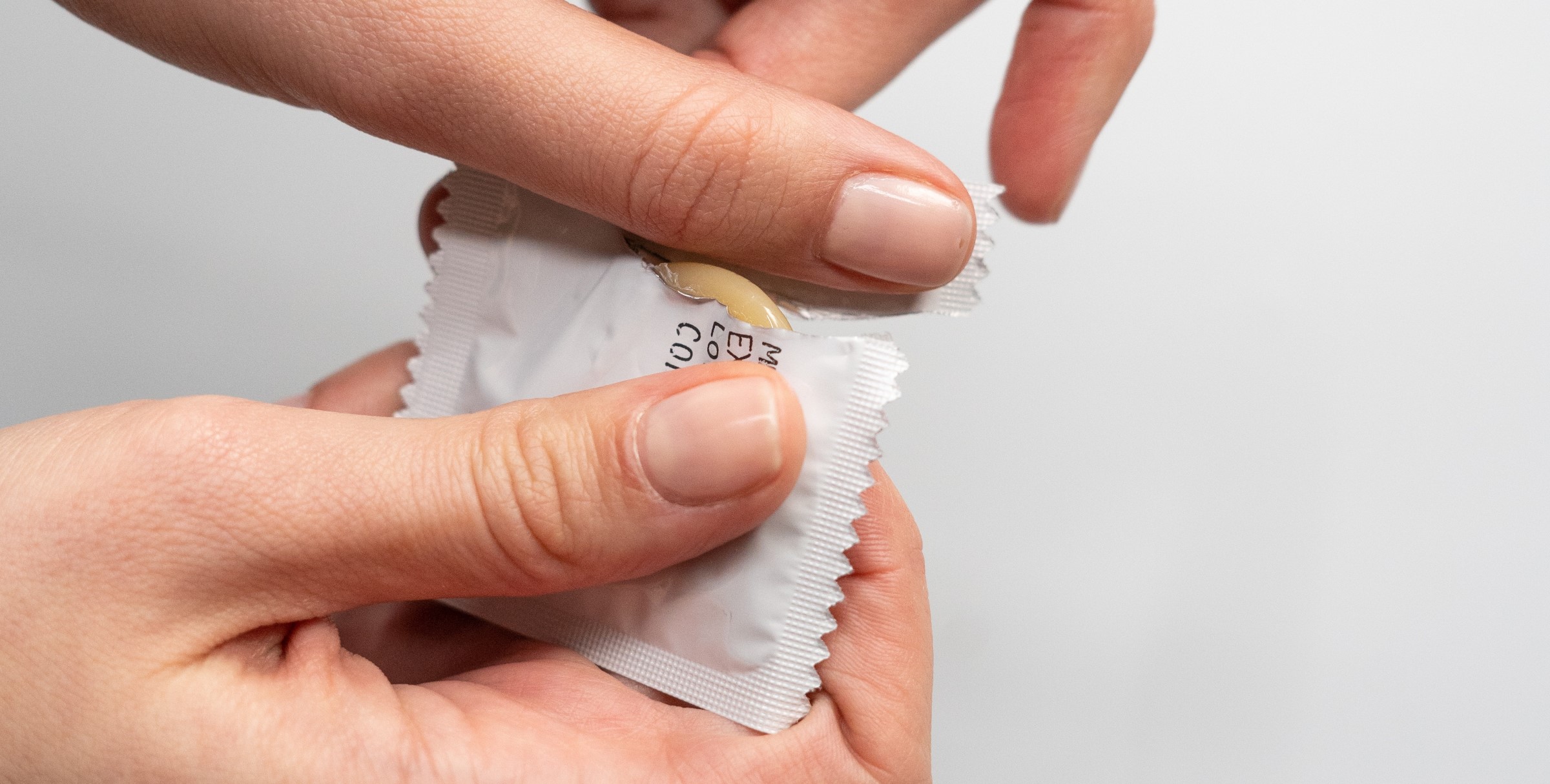
- Open the packet carefully. Don’t use your teeth, as they could rip the condom.
- Put the condom on before the penis touches the vagina or anus, once the penis is fully erect.
- Hold the tip of the condom to squeeze out any air, then roll it all the way down to the base of the penis.
- If it won’t roll down, it’s probably the wrong way round. Throw it away and use a new one.
- Keep the condom on until you’ve finished having sex. When you pull out, hold the base of the condom so it doesn’t come off.
- Wrap the used condom in tissue and put it in the bin, not down the toilet.
Don’t use two condoms at once, as this can make one or both split. That includes wearing an external condom with an internal one.
Which lubricant is safe with condoms?
Extra lubricant can help stop a condom tearing, but it needs to be the right kind:
- With latex condoms, use water-based or silicone-based lubricant. Oil-based products, like petroleum jelly, baby oil, massage oil or body lotion, can make latex condoms split.
- Polyisoprene condoms can’t be used with oil-based lubricant either, but polyurethane condoms can.
- Some thrush creams and pessaries can damage latex. The NHS advises not using latex condoms while you’re using antifungal medicine on or around your genitals or anus.
- If you or your partner is allergic to latex, use polyurethane or polyisoprene condoms instead.
- Avoid condoms with spermicide (nonoxynol-9), which can cause irritation.
Read more in “Can condoms cause yeast infections? Separating myths from facts”
How to store condoms
How you store condoms affects how well they work:
- Keep them somewhere cool and dry.
- Don’t keep them in a wallet, bag or pocket for long, as warmth and rubbing can damage them.
- Check the use by date before you use one. An expired condom may not work.
- Don’t use a condom if the packet is damaged or the condom has any tears or defects.
What to do if a condom splits, slips off or was reused
If a condom splits, slips off or has been reused, get help quickly, as you may need emergency contraception or an STI test.
Emergency contraception works best as soon as possible:
- A copper IUD can be fitted up to 5 days after sex, and it’s the most effective option.
- The levonorgestrel pill (Levonelle) works up to 3 days (72 hours) after sex.
- The ulipristal pill (ellaOne) works up to 5 days (120 hours) after sex.
You can get the emergency pill from most pharmacies. If there was a risk of HIV, PEP (emergency HIV medicine) needs to be started within 72 hours, so get urgent medical care straight away.
STI tests need time after sex to give a reliable result:
- Chlamydia and Gonorrhoea: from 2 weeks after sex
- HIV: from 45 days with a lab test
- Syphilis: a test in the first 3 months after sex can miss the infection, so you may need a repeat test
If you have symptoms, like discharge, pain when you pee or a sore, get tested straight away. Read more in “My condom broke. What should I do now? First steps and when to test”
Other ways to protect yourself
Condoms aren’t the only barrier you can use:
- Internal (female) condoms go inside the vagina or anus. They’re up to 95% effective at preventing pregnancy when used correctly, and like external condoms, they’re for one use only.
- Dental dams are thin squares of latex or polyurethane that cover the vulva or anus during oral sex. Use a new one each time, and keep the same side against the genitals.
Other contraception, like the pill, the implant or the coil, doesn’t protect against STIs. Condoms are the only method that protects against both pregnancy and STIs.
Even a new condom used perfectly doesn’t cover all the skin around the genitals. Herpes, HPV and Syphilis can still pass on through skin contact. Read more in “3 STIs you can catch even if you use a condom”
Which test do you need?
Better2Know offers:
- Full Screen: tests for 7 infections, including Chlamydia, Gonorrhoea, HIV, Syphilis and Hepatitis B, from 28 days after sex, with results in 3 days (5 days for the home test). If you test before 45 days, a negative HIV result needs a repeat test. You can book it at one of our clinics or order a Full Screen home test.
- Peace of Mind: if you want to test sooner, it checks for Chlamydia, Gonorrhoea and Syphilis from 14 days after sex, with results in 2 days.
- Platinum Screen: our most comprehensive STI screen. It tests for 12 infections, adding Hepatitis C, Herpes 1, Herpes 2, Trichomonas and Gardnerella to the Full Screen, from 28 days after sex, with results in 3 days. If you test before 45 days, a negative HIV result needs a repeat test.
All three include a Syphilis test. A Syphilis test in the first 3 months after sex can miss the infection, so you may need a repeat test. If you had receptive anal sex, add a Chlamydia and Gonorrhoea (Rectal Swab) test. Not sure which test you need? Our Patient Care Team is available 24/7 on 020 7099 0955.
FAQs
Can you reuse a condom if you didn’t ejaculate?
No. The condom has still been in contact with body fluids and skin, and pre-cum can carry STIs. Use a new condom every time you have sex. Read more in “Can you pass on or catch an STI without ejaculation?”
Do you need a new condom if you switch from anal to vaginal sex?
Yes. Brook advises using a new condom when you switch from anal to vaginal sex, or the other way round.
Is it safer to wear two condoms?
No. Two condoms rub against each other, which can make one or both split. One condom, put on properly with the right lubricant, gives you the best protection.
Final thoughts
A condom is made to be used once. Using a new one every time, putting it on properly and choosing the right lubricant are the simplest ways to make sure it protects you. If a condom has split, slipped off or been reused, act quickly on emergency contraception and PEP if you need them, then test for STIs at the right time.
Book a Full Screen at a clinic near you or order a home test kit from 28 days after sex. Our Patient Care Team is available 24/7 on 020 7099 0955.
About this article
Not in the UK? Choose your country from the selector at the top of the page for local tests and prices.
This article was last updated on 30 September 2026.
Medical review. This article was medically reviewed by Dr Steve Chapman, Doctor with a wealth of clinical experience in the field of STIs, on 29 April 2025. It is general information and not a substitute for personal medical advice.
Sources
- NHS, Condoms, reviewed 26 January 2024. https://www.nhs.uk/contraception/methods-of-contraception/condoms/
- NHS, Internal (female) condoms, reviewed 15 February 2024. https://www.nhs.uk/contraception/methods-of-contraception/internal-condoms/
- Brook, Condoms, updated 1 July 2026. https://www.brook.org.uk/your-life/condoms/
- Brook, 12 common mistakes when using condoms, updated 27 July 2026. https://www.brook.org.uk/your-life/condoms-common-mistakes/
- Brook, How do I use a condom?, updated 28 July 2026. https://www.brook.org.uk/your-life/how-do-i-use-a-condom/
- Brook, Find the best condom for you, updated 14 July 2025. https://www.brook.org.uk/your-life/best-condom-for-you/
- Brook, Dental dams, updated July 2024. https://www.brook.org.uk/your-life/dental-dams/
- Centers for Disease Control and Prevention, How to use a condom, reviewed 3 April 2024. https://www.cdc.gov/condom-use/resources/external.html
- Sanders SA, Yarber WL, Kaufman EL, et al. Condom use errors and problems: a global view. Sexual Health, 2012. https://connectsci.au/sh/article/9/1/81/184633/Condom-use-errors-and-problems-a-global-view
- NHS, Emergency contraception, reviewed 31 January 2024. https://www.nhs.uk/contraception/emergency-contraception/
- NHS, HIV and AIDS: prevention, reviewed 9 July 2025. https://www.nhs.uk/conditions/hiv-and-aids/prevention/
- NHS, Human papillomavirus (HPV), reviewed 10 March 2026. https://www.nhs.uk/conditions/human-papilloma-virus-hpv/
- British Association for Sexual Health and HIV, Summary guidance on testing for sexually transmitted infections, 2023. https://www.bashh.org/_userfiles/pages/files/resources/bashh_summary_guidance_on_stis_testing_2023.pdf
- British HIV Association, British Association for Sexual Health and HIV and British Infection Association, Adult HIV testing guidelines, 2020. https://bhiva.org/wp-content/uploads/2024/10/HIV-testing-guidelines-2020.pdf
- British Association for Sexual Health and HIV, UK guidelines for the management of syphilis, 2024. https://bashh.org/_userfiles/pages/files/syphilis_2024.pdf