

 7 minutes read7 minutes read
One of the things you learn very quickly about STIs is all the different ways you can get some infections.
Herpes stands out from other STIs in this category. You might be surprised at all the different places someone can get a Herpes infection.
Yes, you can get Herpes around your mouth and genitals, but you can also get the infection in your anus, eyes, and on your fingers.
It’s also not uncommon for many people to get a Herpes outbreak on their tongue. This is often referred to as Mouth Herpes, which is another way to describe Oral Herpes infections, including those that appear on the tongue.
So, what’s going on here? What does Herpes tongue look and feel like? Why could you get it? And what should you do about it if it happens?
Keep reading to find out more.
What is Herpes?
First things first: let’s talk about Herpes.
Herpes infections are caused by the family of Herpes Simplex Virus, of which there are two types: Herpes Simplex Virus Type 1 (HSV 1) and Herpes Simplex Virus Type 2 (HSV 2).
HSV 1 is the virus that tends to cause Oral Herpes. HSV 2 tends to cause Genital Herpes.
However, it’s important to note that it’s possible to get an HSV 1 infection on your genitals and an HSV 2 infection in your mouth. Both the mouth and genitals can be infected by either type.
Herpes infections of both kinds are relatively common in Australia. It’s estimated that around 75% of Australians carry HSV-1 and 10% carry HSV-2. Both HSV 1 and HSV 2 are types of Herpes virus. Once you are infected, the virus is present in your body permanently.
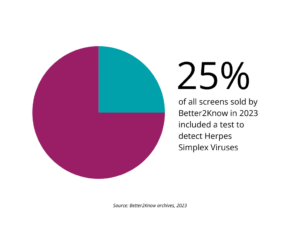
Better2Know also sees a lot of demand for Herpes testing in Australia. Around 25% of all screens sold to Australian customers include tests for either HSV-1 or HSV-2.

Better2Know also sees a lot of demand for Herpes testing in Australia. Around 25% of all screens sold to Australian customers contain tests for either HSV 1 or HSV 2.
What are the symptoms of Herpes?
It’s important to note that you can have a Herpes infection without experiencing any symptoms. Many people who contract HSV-1 or HSV-2 are completely asymptomatic.
But when symptoms do occur, they can vary greatly from person to person. Some people may experience mild symptoms, while others can have very severe symptoms.
When we first get exposed to the virus, an initial HSV-1 infection around the mouth is often the most severe and usually causes pain or burning in or around the mouth. This is due to painful blisters or open sores (ulcers). These blisters often appear within the first few days after exposure.
Symptoms of Oral Herpes typically appear four to 12 days later. Your first outbreak may cause severe flu-like symptoms, including fever, swollen lymph nodes, body aches, and muscle aches. Some individuals may experience tingling, burning, or itching before sores appear around the mouth.
Early symptoms of an HSV-2 infection can include fever, body aches, muscle aches, and swollen lymph nodes. These are followed by the appearance of blisters or open sores in the genital or anal area. Sores located inside the vagina are typically only observed during the first outbreak, if at all.
Once you get Herpes, the infection is permanent and can’t be cured. The first outbreak of Herpes is generally the most severe. After your first outbreak, you will likely get recurrent outbreaks with less severe symptoms over time.
How does Herpes spread?
Most Herpes infections spread through intimate contact – usually through kissing, oral sex, vaginal sex, and anal sex – by physically touching the sores of an infected person. Mouth-to-mouth contact and other forms of oral contact, like kissing, are common ways Herpes can be transmitted.
While very rare, Herpes can also spread through sharing things like toothbrushes, cigarettes, eating utensils, and lip balm, especially if the infected person is experiencing an outbreak.
However, Herpes can also be spread even when there are no symptoms through a process known as “asymptomatic shedding”, where the virus can migrate to the surface of the skin and spread to others without causing a sore or blister.
What causes Herpes on the tongue?
When Herpes symptoms occur in or around the mouth, sores or blisters can sometimes appear on the gums, palate, roof of the mouth, and the tongue. These herpes blisters are often painful, fluid-filled lesions that may be preceded by burning or tingling sensations and progress from redness to crusting over as they heal.
If you got a Herpes outbreak on your tongue, you probably got it by performing unprotected oral sex on a person infected with Genital Herpes.
What does Herpes on the tongue feel like?
A Herpes outbreak on the tongue typically goes through several stages and may feel like:
- Initial discomfort: You may notice redness, swelling, itchiness, or pain in a specific area of your tongue. This is likely where the sore will appear.
- Formation of blisters: Small red bumps begin to appear, sometimes in clusters in the area of the outbreak, but may be dispersed all around the mouth and tongue. These bumps become blister-like, with clear or cloudy fluid inside. They will probably burst as you eat food and brush your teeth.
- Progression of symptoms: The blisters start with mild discomfort and progress to increasingly painful sores. The pain can be considerable, making eating, talking, and swallowing difficult. During this active infection stage, symptoms are present, and the virus is most contagious. Pain relief can include over-the-counter anti-inflammatories like ibuprofen or acetaminophen, as well as topical anaesthetics to reduce discomfort. Home remedies, such as keeping the infected area clean and dry, can also support the healing process.
- Healing phase: The sores on the tongue eventually heal.
Distinguishing tongue Herpes from other conditions
Herpes on the tongue can sometimes look and feel similar to other common mouth problems, making diagnosis tricky. HSV often causes painful blisters or ulcers, but these symptoms can overlap with other oral conditions like canker sores, allergic reactions, and even oral thrush.
- Canker sores, also known as aphthous ulcers, are small, round, and usually white or yellow with a red border. Unlike HSV infections, canker sores are not caused by a virus and are not contagious. They tend to appear inside the mouth, including on the tongue, but they don’t form fluid-filled blisters as Herpes sores do. Canker sores are often triggered by stress, minor mouth injuries, or certain foods.
- Allergic reactions in the mouth can also cause redness, swelling, or sores, but these are usually linked to a specific food, medication, or dental product. Allergic reactions don’t cause clusters of blisters or recurring outbreaks.
- Oral thrush, a yeast infection, can cause creamy white patches on the tongue and inside the mouth, sometimes leaving a red, sore area underneath.
If you notice unusual sores, blisters, or ulcers in your mouth that don’t heal within two weeks, or if you’re experiencing frequent outbreaks, it’s important to see a healthcare provider.
How can I prevent getting Herpes on the tongue?
Preventing a Herpes outbreak on the tongue involves a combination of lifestyle changes, safe practices, and medical treatments:
- Avoid intimate contact: Avoid kissing, oral sex, and close touching with anyone who has visible sores.
- Use barrier methods during sex: Use condoms or other protective barriers, such as dental dams, whenever you have sex. Herpes can be transmitted when receiving oral sex, so using protection like condoms and dental dams during oral, vaginal, and anal sex can help prevent herpes transmission.
- Don’t share personal items: Avoid sharing items that a person with the infection has used, such as lipstick, utensils, or shaving equipment.
Medical treatment, including antiviral treatments, can help prevent outbreaks and reduce the risk of transmitting herpes to others. These treatments are especially important for long-term management and when sores are active.
How long does Herpes on the tongue last?
After an outbreak, it can take at least 10 days for blisters to burst and heal, but healing may be longer during the initial infection. The typical duration for herpes on the tongue to resolve is seven to 14 days, although initial infections can last up to two to four weeks.
When should I get tested?
Many people worry about when to get tested. But the answer is pretty straightforward.
In the context of Herpes, you should certainly get tested once you notice the telltale symptoms of a Herpes infection, including:
- Tingling, burning or pain around the mouth or genitals
- The appearance of sores or fluid-filled blisters around the mouth, genitals, or anus
But experiencing symptoms shouldn’t be the only reason you get tested. You should also get tested if a previous sexual partner tells you that they have an STI.
You don’t need to have done anything in particular to get tested for STIs. Simply being concerned about your sexual health is a good enough reason.
When should I see a doctor?
If your symptoms persist for more than two weeks, if your symptoms are severe, and you know you have caught a Herpes infection following receipt of a positive test result, you should reach out to a medical professional.
You should see your doctor if:
- This is the first time you’ve had an outbreak
- You have a weakened immune system
- Your sores don’t heal within two weeks
- Your symptoms are severe or so painful that you have trouble with everyday tasks, like eating, drinking, urinating, or performing at your job
- You have outbreaks often
How is tongue Herpes treated?
Tongue herpes can be managed with a combination of antiviral treatments and other therapies. To effectively treat Herpes, early intervention is important to reduce symptoms and prevent transmission.
- Antiviral oral medications: Antiviral treatments are traditionally the most effective for treating Herpes.
- Over-the-counter topical anaesthetics or anti-inflammatory agents: These can help alleviate symptoms if the pain is severe enough to interfere with daily functioning.
- OTC pain relievers: Over-the-counter pain relievers can be used to manage pain, but antibiotics are not effective against this viral infection.
- Medicated rinses: A dentist may recommend medicated rinses and suggest avoiding certain toothpaste ingredients.
Herpes outbreaks can be very uncomfortable. However, if you seek the right care and treatment, you can minimise the worst effects of an outbreak.
Final thoughts
Herpes outbreaks can be very uncomfortable. However, if you seek the right care and treatment, you can minimise the worst effects of an outbreak.
If you think you may have Herpes, get tested with Better2Know’s Comprehensive Screen.
This article first appeared on 24/05/2024. Last updated 06/02/2025.
This article has been medically reviewed by Dr. Steve Chapman, 04/08/2025.