

 7 minutes read7 minutes read
Summary:
- Yes, you can catch Chlamydia without anyone cheating. Most people with Chlamydia have no symptoms, so one partner may have had it since before the relationship started without knowing.
- A test cannot tell you how long you have had Chlamydia or who it came from, so a positive result is not proof that anyone has been unfaithful.
- Chlamydia is treated with antibiotics, and both partners should be tested. The Better2Know Full Screen tests for Chlamydia and 6 other infections from 28 days after sex.
Chlamydia is a sexually transmitted infection (STI) caused by the bacterium Chlamydia trachomatis. It is the most commonly diagnosed STI in England, and it is sometimes called “the silent STI” because it can go unnoticed for a long time.
Chlamydia is often linked with cheating or having several partners, but the reality is more complicated. It is entirely possible to find Chlamydia in a committed, faithful relationship.
In this blog, we explain how you can catch or pass on Chlamydia without anyone being unfaithful, and what to do if you or your partner test positive.
How couples can get Chlamydia even if no one’s cheated
You can catch Chlamydia without anyone cheating. Chlamydia often causes no symptoms, so one partner may have caught it long before the relationship started without knowing. It can then be passed on at any point in the relationship. A positive test on its own does not mean that anyone has been unfaithful.
Most people who have Chlamydia do not have any symptoms. When symptoms do appear, they can include a burning feeling when peeing and unusual discharge from the vagina, penis or bottom. Women may also have pain in the lower tummy, bleeding after sex or bleeding between periods, and men may have pain and swelling in the testicles. Because symptoms are so often missing, many people only find out they have Chlamydia when they get tested.
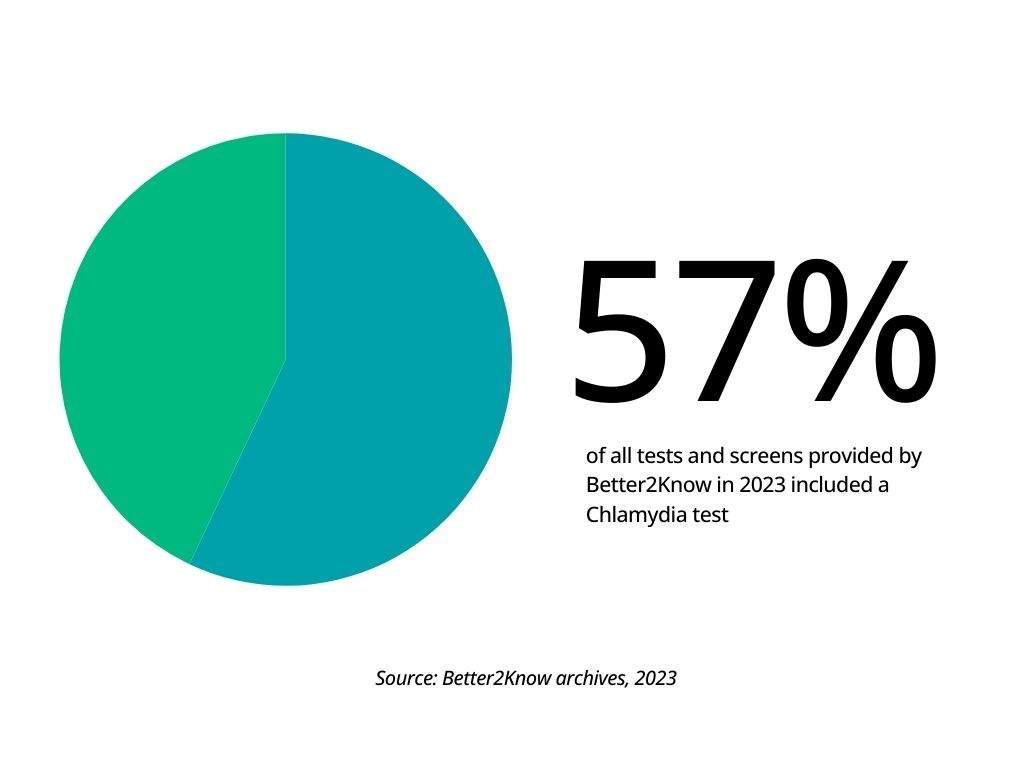
This is why Chlamydia is one of the most tested-for STIs. In 2023, around 57% of all tests and screens provided by Better2Know in the UK included a test for Chlamydia.
Chlamydia is also the most commonly diagnosed STI in England. There were 151,163 Chlamydia diagnoses in England in 2025, making up 45.2% of all new STI diagnoses, according to the UK Health Security Agency. The more people get tested, the more infections without symptoms are found and treated.
How Chlamydia spreads
Chlamydia is spread through semen and vaginal fluid. It can be passed on through vaginal, anal or oral sex without a condom.
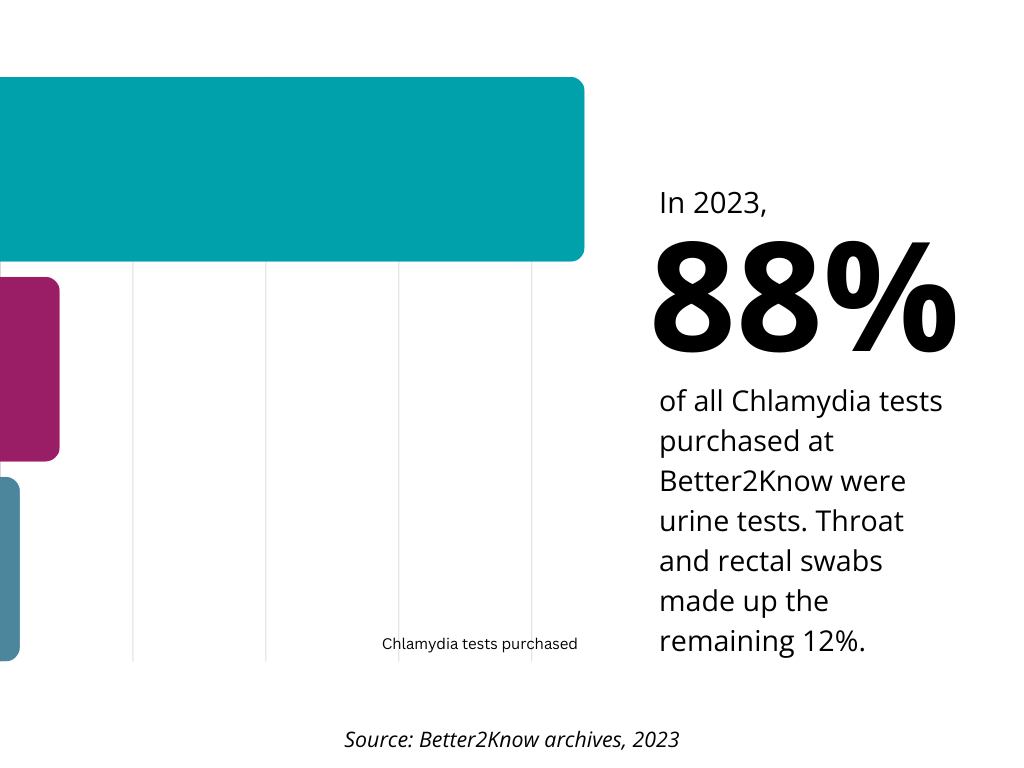
In 2023, around 88% of all Chlamydia tests bought from Better2Know were urine tests, which detect genital infections. The rest were throat and rectal swabs. Rectal swabs detect Chlamydia in the rectum, which can be caught through anal sex.
Chlamydia can also spread through other types of sexual contact. If you give oral sex to a partner with a genital Chlamydia infection, you can get a Chlamydia infection in your throat. Our guide to what an oral Chlamydia infection looks like explains the signs.
Sharing sex toys that have not been washed or covered with a new condom can also pass Chlamydia between partners. Find out how long an STI can stay on a sex toy.
Despite a popular myth, you can’t get Chlamydia from kissing.
What should you do if you or your partner has Chlamydia?
The last thing anyone in a committed relationship wants to think about is STIs.
But if you think you or your partner might have Chlamydia, it’s best to talk to them about it. Plan what you are going to say, choose a good time and place, and try to stay calm. Try not to jump to conclusions or make big decisions in the heat of the moment.
You should both get tested. If either of you tests positive, you will both need treatment, and you should avoid vaginal, anal and oral sex until you have both finished it and tests show the infection has gone. If you test with Better2Know and your result is positive, we will help you arrange treatment.
It helps to know that a test cannot show how long you have had Chlamydia or who it came from. A positive result can still be hard to deal with, so be ready for that possibility, and remember that it does not prove anyone has cheated.
This is why Better2Know recommends that you and a new partner both get tested for a full range of STIs once you know the relationship is going to continue. If either of you tests positive for an infection like Chlamydia, it is much easier to deal with early than months or years later. Our guide on which STI test to choose after a new partner can help you decide.
Long-term effects of untreated Chlamydia
One thing is clear: if you have an STI, it’s always better to know.
Chlamydia is easy to treat with antibiotics. But if it is not treated, it can spread to other parts of the body and cause long-term health problems, particularly for women.
Pelvic inflammatory disease (PID)
Untreated Chlamydia can cause pelvic inflammatory disease (PID), an infection of the womb, fallopian tubes and ovaries. It happens when the infection spreads up from the cervix. PID can cause long-lasting pelvic pain and can scar the fallopian tubes. Early treatment of Chlamydia helps prevent it.
Ectopic pregnancy
Damage to the fallopian tubes raises the risk of an ectopic pregnancy, where a fertilised egg implants outside the womb, usually in a fallopian tube. An ectopic pregnancy can be life-threatening and needs urgent medical care.
Infertility
Scarring of the fallopian tubes can block the path of eggs from the ovaries to the womb, which can make it harder to get pregnant. Read more in our post “Can Chlamydia make you infertile?”
Infection in the testicles
In men, Chlamydia can cause an infection in the testicles. It can spread to the epididymis, a coiled tube at the back of each testicle that stores and carries sperm, making it swollen and painful. This is called epididymitis.
Reactive arthritis
Chlamydia can sometimes trigger reactive arthritis, where the joints become sore and swollen. It can also cause sore, red eyes and pain when peeing, and it usually gets better within a few months.
Higher risk of HIV
Untreated Chlamydia may make it easier to catch or pass on HIV.
Regular testing and early treatment are the best ways to prevent these complications.
How to prevent Chlamydia in a relationship
While catching Chlamydia without cheating is possible, there are simple steps couples can take to lower the risk.
Get tested together
Both partners should have an STI test before starting a new sexual relationship, and after any sexual contact outside the relationship.
Use condoms
Using a condom every time you have vaginal, anal or oral sex lowers the risk of passing on Chlamydia and other STIs. A dental dam can be used for oral sex on the vagina or anus.
Wash or cover sex toys
If you share sex toys, wash them after each use or cover them with a new condom each time.
Talk openly
Talking openly and honestly about sexual health, testing and any possible exposure is one of the best ways to protect you both. Read more in “Can you get an STI in a relationship even if no one’s cheated?”
How to test for Chlamydia
Testing for Chlamydia is simple. A urine sample finds genital infections, and swabs can check the throat or rectum if you have had oral or anal sex. If you have symptoms, get tested straight away.
The Better2Know Full Screen is a good choice for couples, as it tests for 7 infections: Chlamydia, Gonorrhoea, Hepatitis B, HIV, Mycoplasma, Syphilis and Ureaplasma. It uses a blood and urine sample and can be taken from 28 days after sex, with results in 3 days at a clinic. You can book it at one of our clinics across the UK or order a Full Screen home test kit.
If you test positive, Chlamydia is treated with antibiotics, either as a single dose or as a course of tablets for 7 to 14 days. Your current partner and any recent partners should also be tested and treated, even if they have no symptoms.
FAQs
How long can you have Chlamydia without knowing?
Chlamydia can go unnoticed for a long time, because most people who have it do not have any symptoms. Testing is the only way to know for sure.
Can Chlamydia lie dormant?
Chlamydia often causes no symptoms, so an infection can go unnoticed for a long time. That is why it can seem to appear out of nowhere in a relationship. Testing is the only way to know whether you have it, and antibiotics can treat it. You can catch it again after treatment from a partner who has not been treated, which is why both partners need testing and treatment.
Can a test tell how long I have had Chlamydia?
No. A Chlamydia test shows whether you have the infection now, but it cannot show when you caught it or who it came from.
Does my partner need to be tested if I have Chlamydia?
Yes. Your current partner and any recent partners should be tested and treated, even if they have no symptoms. You should both avoid vaginal, anal and oral sex until you have finished treatment and tests show the infection has gone.
Final thoughts
Finding out that you or your partner has Chlamydia can be worrying, but it does not mean anyone has cheated. Chlamydia often causes no symptoms and can go unnoticed for a long time, so it may have started before your relationship began.
The best thing you can do is get tested together and, if needed, treated together. Book a Full Screen at a clinic near you or order a home test kit. If you would like help choosing a test, our Patient Care Team is available 24/7 on 020 7099 0955.
About this article
Not in the UK? Choose your country from the selector at the top of the page for local tests and prices.
This article originally appeared on 26 April 2024 and was last updated on 29 September 2026.
Medical review. This article was medically reviewed by Dr Steve Chapman, Doctor with a wealth of clinical experience in the field of STIs, on 2 October 2024. It is general information and not a substitute for personal medical advice.
Sources
- UK Health Security Agency, Sexually transmitted infections and screening for chlamydia in England: 2025 report, 2 June 2026. https://www.gov.uk/government/statistics/sexually-transmitted-infections-stis-annual-data-tables/sexually-transmitted-infections-and-screening-for-chlamydia-in-england-2025-report
- NHS, Chlamydia, reviewed 24 October 2024. https://www.nhs.uk/conditions/chlamydia/
- NHS, Epididymitis, reviewed 6 August 2024. https://www.nhs.uk/conditions/epididymitis/
- NHS, Reactive arthritis, reviewed 16 December 2024. https://www.nhs.uk/conditions/reactive-arthritis/
- Centers for Disease Control and Prevention, About Chlamydia, reviewed 31 January 2025. https://www.cdc.gov/chlamydia/about/index.html
- Better2Know test data, 2023.